
Ant Control · Jul 14, 2026
Argentine Ants in San Diego: Why the Tiny Brown Ant in Your Kitchen Is Actually an Invasive Species
Argentine ants dominate San Diego kitchens every summer. Learn why they invade, how to identify them, and what actually stops them long-term.
By Philippe Heller, President · Bite Away Termite & Pest Control · Serving San Diego since 2005
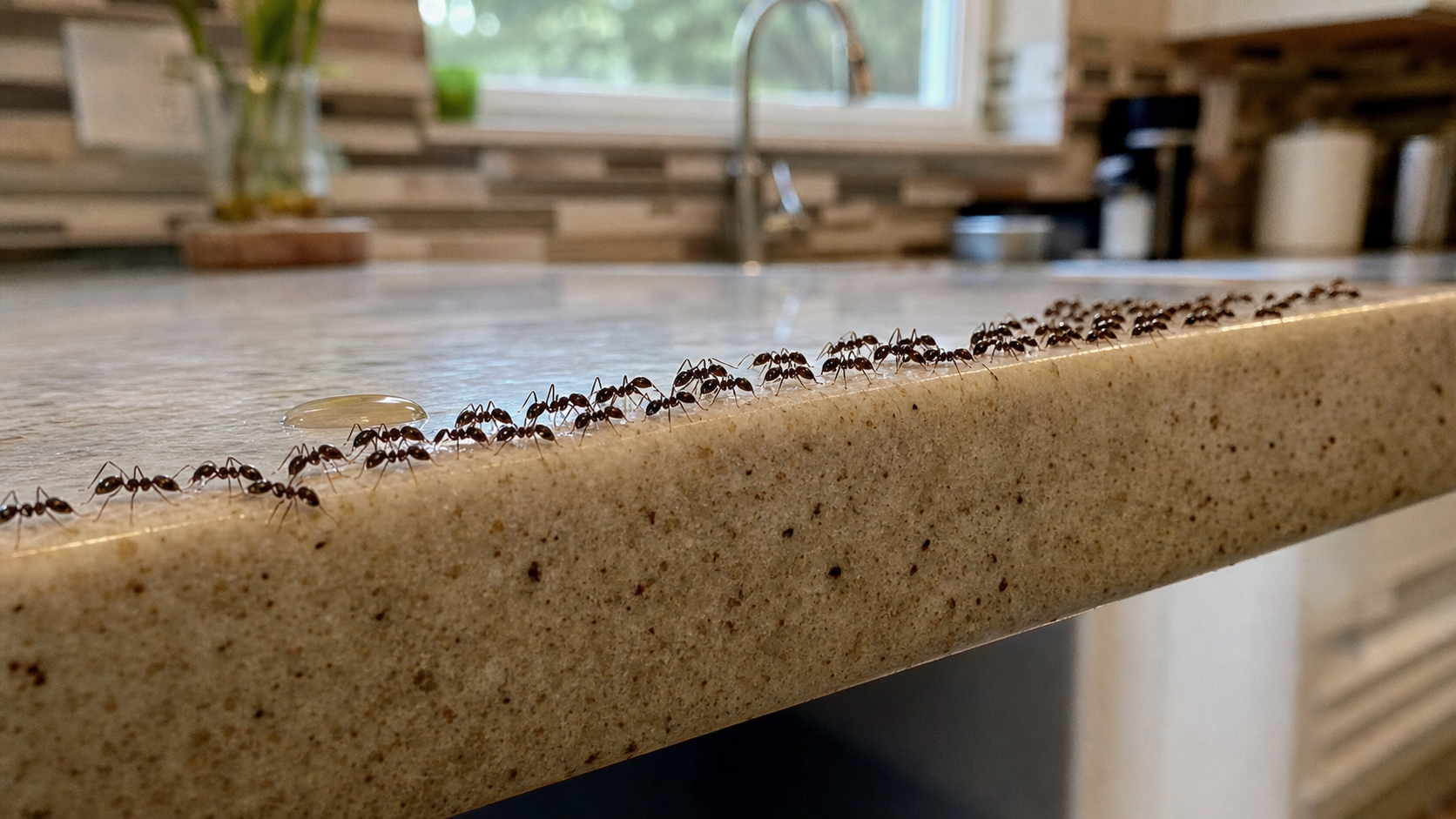
The tiny brown ant that took over Southern California
If you live in San Diego and you've had ants in your kitchen this week, they were almost certainly Argentine ants. It's not "just ants" — it's one specific invasive species that has quietly rewritten Southern California's ant ecosystem over the last century.
Argentine ants (Linepithema humile) are the small, uniformly brown ants — about 2.5 to 3 millimeters long — that show up in single-file trails on countertops, along baseboards, and around pet food bowls every summer. They are native to the Paraná River basin in South America, but they arrived in the United States through the port of New Orleans in the 1890s and reached California by the early 1900s. Today they are so widespread across coastal Southern California that researchers refer to the local population as a single "supercolony" that stretches from San Diego north through the Bay Area, all sharing the same genetic markers and refusing to fight one another.
That last detail matters. In their native South American range, Argentine ant colonies attack neighboring colonies constantly, which limits their expansion. In California, they don't. Colonies merge instead of fighting, which is why your neighbor's ants, your ants, and the ants at the park down the street are functionally one gigantic organism spread across the entire coast.
Why they explode in San Diego every summer
Argentine ants need three things to thrive: moisture, warmth, and a food source. San Diego summers deliver all three, plus a fourth accelerant most homeowners don't think about — irrigation.
Argentine ants nest in shallow, moist soil. During cooler months they can survive comfortably outdoors. When our dry-summer climate hits and outdoor soil bakes to a crust by July, the colonies migrate toward the only remaining moisture in the neighborhood: irrigated landscaping, dripping outdoor faucets, and inside your home. That's the same reason they seem to appear "out of nowhere" after the first real heat wave of the season. They aren't reproducing faster in July — they're relocating.
Once inside, they follow chemical trails (pheromones) to any available food or water source. A single scout finds a crumb, a pet bowl, or condensation under a sink, then lays a trail back to the colony. Within a few hours, you're looking at a full trail of workers. This is why "just wiping them up with a paper towel" almost never works — the trail is chemical, and until you disrupt the chemistry, they keep coming back to the same spot.
How to identify Argentine ants (vs. other San Diego ants)
Not every ant in a San Diego kitchen is Argentine, and correct ID matters because different species require different treatment.
Argentine ants are:
- Uniformly light-to-medium brown
- About 2.5–3 mm long (workers all the same size)
- Move in long, orderly trails, often single file
- Do not sting or bite in a way you'd notice
- Emit a faint musty smell when crushed
Odorous house ants (also common in San Diego) look similar in size but are darker brown to black and give off a strong rotten-coconut smell when crushed — this is the easiest field ID difference.
Pavement ants are slightly larger, darker, and typically stay near foundation cracks and driveways rather than climbing counters.
Southern fire ants (rare in urban San Diego but present in outlying areas like Ramona and East County) are reddish and sting aggressively. If you're being stung, it's not Argentine ants — call a professional.
Carpenter ants are much larger (6–13 mm), black or dark red, and indicate a moisture or wood damage problem, not a food problem.
If you're not sure, take a phone photo of a single ant against a light background with something for scale (a coin, a grain of rice). We can identify it from the image.
What actually works — and what doesn't
Argentine ant control frustrates homeowners because the species is uniquely resistant to the tactics that work on almost every other pest. Here's what the University of California Statewide Integrated Pest Management Program has documented, and what we see confirmed in San Diego homes every week.
What doesn't work:
- Spraying visible ants with contact killer. You kill the trail you can see. The colony has hundreds of thousands to millions of workers behind the wall or under the yard. New workers replace the dead ones within 24–48 hours.
- Vinegar or essential oil sprays. These temporarily disrupt the pheromone trail but do nothing to the colony. Ants find a new route in a day or two.
- Repellent perimeter sprays applied by untrained homeowners. Argentine ants respond to certain repellent chemistries by budding — splitting the colony into multiple smaller colonies to escape the repellent. You can turn one colony into six.
- Chalk lines, cinnamon, coffee grounds. No documented effect on established Argentine ant colonies.
What does work:
- Non-repellent liquid bait stations placed directly on active foraging trails. Argentine ants share food (a behavior called trophallaxis), which lets a slow-acting bait travel from foragers back to the queens over several days. Done correctly, this collapses the colony from the inside.
- Exterior perimeter treatment with non-repellent, transferable actives. Applied at the correct time of year (early spring before the summer migration begins), this dramatically reduces the population that reaches the structure in July and August.
- Removing the water source. Fix leaking irrigation, adjust drip lines away from the foundation, and repair any indoor leaks. Argentine ants come inside primarily for water in summer, not food.
- Trimming vegetation off the house. Any branch, shrub, or vine touching the exterior is a bridge that bypasses your perimeter treatment.
- Sealing entry points. Weather-strip doors, seal utility penetrations, and caulk gaps around exterior faucets, but understand that you can't seal them out completely — they're small enough to enter through cracks you can't see. Sealing is one lever, not the whole solution.
What we do differently on Argentine ant jobs
Argentine ant treatment is one of the most common calls we run all summer, and it's also one of the most misunderstood. The mistake most homeowners make — and, honestly, most quarterly pest control services make — is treating the visible trail rather than the colony structure.
When we come out for an Argentine ant issue, we:
- Walk the property looking for the actual nest sites (usually under landscaping mulch, along irrigation lines, or in soil pressed against the foundation).
- Identify the entry points where trails cross the structure.
- Place non-repellent bait at strategic points on active trails so workers carry it back to the colony.
- Apply a non-repellent exterior perimeter treatment with a transferable active ingredient.
- Address moisture and vegetation issues that will bring the next generation right back if untreated.
Most Argentine ant cases in San Diego respond within 7–14 days when treated this way. The trails inside the house typically disappear within the first few days as the bait begins killing the connected workers.
When to call us vs. handle it yourself
For a light trail on a single counter, a well-placed store-bought liquid bait (the kind labeled specifically for sweet-eating ants, containing borax or a slow-acting insecticide) can often resolve it if you place it directly on the trail and leave it alone for 3–5 days. Do not spray anything nearby — that will drive the ants away from the bait and defeat the purpose.
If you're seeing multiple trails in multiple rooms, trails that keep returning after treatment, or ant activity that has persisted through more than one summer, the colony is large enough that a professional treatment will resolve it faster and more permanently than continued DIY effort. This is especially true if you have a home with irrigated landscaping (nearly every San Diego home), because the outdoor colony structure is where the real problem lives.
We serve San Diego, Temecula, Escondido, Poway, La Jolla, and Ramona. If you're seeing Argentine ants and want them handled by someone who treats the colony rather than the trail, we're a phone call away.
📞 888-321-BITE (2483) 🌐 biteawaypest.com/get-a-quote
Sources
- University of California Statewide Integrated Pest Management Program. "Argentine Ant Pest Notes." https://ipm.ucanr.edu/PMG/PESTNOTES/pn7411.html
- Tsutsui, N. D., Suarez, A. V., Holway, D. A., & Case, T. J. (2000). "Reduced genetic variation and the success of an invasive species." Proceedings of the National Academy of Sciences, 97(11), 5948-5953.
- University of California Riverside Center for Invasive Species Research. "Argentine Ant." https://cisr.ucr.edu/invasive-species/argentine-ant
- California Department of Food and Agriculture, Invasive Species. Argentine ant profile.
Need help from a local pro?
Bite Away has served San Diego and Temecula since 2005. Free residential termite inspections and a pest-free guarantee.