
Termite Control · Jul 17, 2026
Termite Swarms in San Diego: What Those Winged Insects on Your Windowsill Really Mean
Winged termites on a San Diego windowsill in spring? That's a swarm — and it means an active colony is nearby. What to do next, from a licensed local company.
By Philippe Heller, President · Bite Away Termite & Pest Control · Serving San Diego since 2005
The most misidentified pest in San Diego
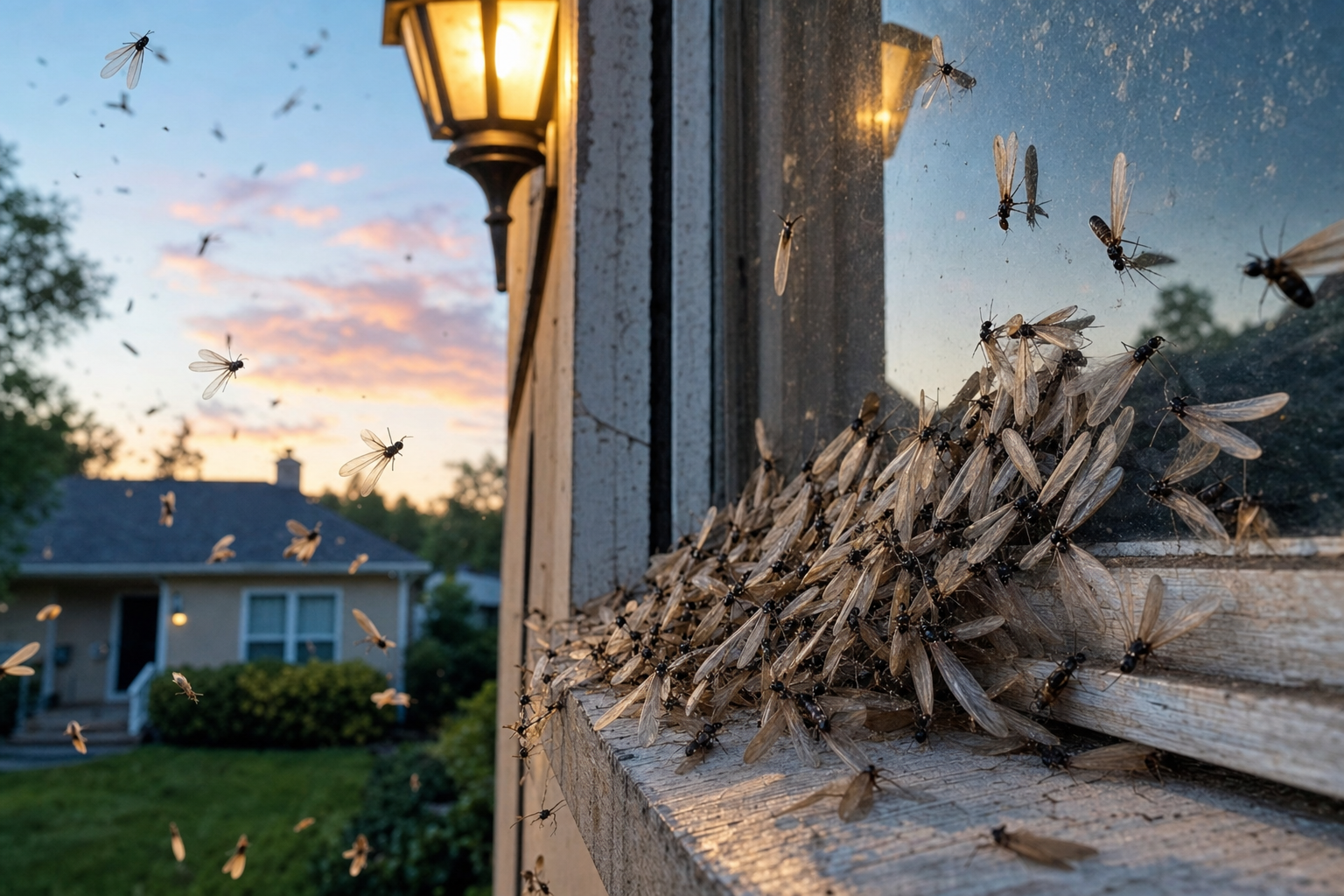
Every spring, from roughly late February through early May, San Diego homeowners walk out to a garage, a porch light, or a windowsill and find dozens or hundreds of small winged insects that weren't there the day before. Almost every one of those calls starts the same way: "I think we have flying ants."
Occasionally that's correct. Usually it isn't. What most people are looking at is a termite swarm — the single most reliable outdoor sign that an active termite colony is living within a few hundred feet of the home, and often within the structure itself.
Termite swarms are also the most misidentified pest event in San Diego, which is a problem because the swarm event is the point at which treatment is most straightforward and least expensive. Miss the signal, and the colony you didn't know about spends another year eating structural wood before you find out during a real estate inspection or a wall repair.
What is a swarm, exactly
Mature termite colonies produce reproductive termites — called alates — once they reach a certain size and age. Alates are the winged, sexually mature males and females whose job is to leave the parent colony, fly a short distance, land, drop their wings, pair up, and start a new colony. A swarm is that mass exit event.
For a homeowner, the practical facts about swarms are:
- Swarms last only a few hours, usually late morning to early afternoon on a warm day, often after a spring rain.
- The winged termites you see are not eating your house at that moment. They are the result of a colony that has been eating something (structural wood, a fence post, a stump, a woodpile, mulch against the foundation) for at least 3–5 years.
- After the swarm, the alates die within a day or two if they don't successfully pair up and burrow. You'll often find piles of translucent, uniformly-sized wings on windowsills, in bathtubs, or near light fixtures — this is the classic post-swarm evidence.
- The wings and the location of the wings are the diagnostic clue. Wings inside the home means the colony is likely inside the structure. Wings outside on the patio or driveway means the colony may be in the yard, a tree, or an outbuilding.
How to tell termite alates from flying ants (30-second field ID)
This distinction matters. Flying ants are a nuisance. Termite alates mean structural damage.
Termite alates have:
- A straight, uniform body — no visible "waist" between segments
- Two pairs of wings of equal length, both longer than the body
- Straight antennae
- Uniformly dark brown or blackish body (in the two species common to San Diego)
Flying ants have:
- A visible pinched "waist" between the thorax and abdomen
- Two pairs of wings of unequal length (front wings noticeably larger than rear)
- Elbowed (bent) antennae
- Body proportions clearly showing three segments
The wing difference is the fastest field check. Termite wings look identical top and bottom; ant wings don't. If you can't tell from a photo, save one of the winged insects in a small container or ziplock bag — we identify from a photo or a specimen for free.
The two termite species that swarm in San Diego
San Diego has two structurally important termite species, and they swarm at different times and in different ways.
Western subterranean termite (Reticulitermes hesperus) is the more damaging of the two economically. Colonies live in soil and access wood through mud tubes on foundations, in crawl spaces, or up through slab cracks. They swarm during daylight hours in spring, typically February through April, especially after rain. Wings are found on interior windowsills or near light-flooded surfaces indoors. If you see a subterranean swarm inside the home, the colony is very likely inside or under the structure.
Western drywood termite (Incisitermes minor) lives entirely inside the wood it's eating — no soil contact required. Drywood colonies swarm later, generally September through November in San Diego, sometimes with a smaller secondary swarm in spring. Drywood evidence tends to include small piles of hexagonal fecal pellets ("frass") the color of coffee grounds or fine sand, in addition to wings.
Which species you're seeing changes the treatment approach entirely — subterranean termites require a soil-treatment or bait system approach; drywood termites are typically treated with localized wood injection, heat, or full-structure fumigation depending on scope.
Why San Diego swarms peak in spring — and what to do that same day
The swarm trigger is a combination of soil temperature, humidity, and daylight length. In San Diego, that combination lines up most reliably in late March and April, particularly on the first warm day after a rain event. A single day can produce swarms in dozens of homes across a neighborhood, which is why we sometimes take five calls in one afternoon from a single ZIP code.
If you see a swarm today, here's what to do:
- Take photos. Get a clear image of the winged insects and, if possible, of any wings shed onto surfaces. If you can safely capture one in a container, keep it — we can confirm the species from a specimen.
- Note the location. Interior windowsill? Exterior porch? Garage? Crawlspace access? The location narrows down where the parent colony is.
- Do not spray them. Killing the visible alates does absolutely nothing to the colony inside your walls. It also destroys the specimen we need for ID.
- Do not disturb suspected damage. If you notice bubbled paint, hollow-sounding wood, mud tubes on the foundation, or piles of pellets, leave them intact for the inspection.
- Schedule a termite inspection within the next 30 days. In San Diego, a swarm is a near-certain indicator that an active colony exists nearby. Waiting a full season before inspecting adds another year of undetected feeding.
Do I need a full inspection, or can I just spot-treat where I saw them?
This is one of the most common questions we get after a swarm. The honest answer depends on what you saw and where.
If you saw a small swarm on the exterior only (a porch light, a patio table), and no interior wings or damage evidence exists, an inspection is prudent but the parent colony may be outside the structure — in a stump, a woodpile, an old fence line — and treatment can sometimes be localized.
If you saw wings inside the house — on a bathroom windowsill, in a bathtub, on a kitchen floor — the colony is almost certainly inside or immediately under the structure. Spot treatment in that scenario is rarely effective because subterranean termite colonies extend well beyond the wood you can see. A full inspection to map the colony's access points, followed by an appropriate soil treatment or bait system, is the reliable path.
Either way, don't rely on the swarm being the last one. A colony that produced 200 alates this spring will produce more next spring, and every year that passes without treatment is more structural wood consumed.
What a Bite Away termite inspection actually looks like
Because The Real Estate Inspection Company (our sister company since 2004) has performed thousands of structural inspections across San Diego County, we approach termite inspections from the perspective of a building inspector as well as a pest professional. A proper inspection includes:
- Full interior review of accessible walls, ceilings, window and door frames, baseboards, and interior wood surfaces
- Full exterior walk of the foundation, siding, eaves, fascia, patio covers, and any wood-to-soil contact points
- Attic and crawlspace inspection where accessible, looking for mud tubes, damaged framing, and moisture indicators
- Identification of any wings, pellets, or damage found, matched to the correct species
- A written report with photos of any findings, and a treatment recommendation with pricing before you commit to anything
If you're in escrow, we can also produce a Wood-Destroying Organism (Section 1/Section 2) report accepted by California lenders.
Local & seasonal reality check
If you're reading this in spring — you're in the window. If you're reading this in fall and seeing wings, you're probably looking at a drywood termite swarm, and the article still applies but the treatment path changes.
We serve San Diego, Temecula, Escondido, Poway, La Jolla, and Ramona. If you've seen a swarm this week, don't wait for it to happen again next spring to find out how big the colony has gotten.
📞 888-321-BITE (2483) 🌐 biteawaypest.com/get-a-quote
Sources
- University of California Statewide Integrated Pest Management Program. "Subterranean and Other Termites Pest Notes." https://ipm.ucanr.edu/PMG/PESTNOTES/pn7415.html
- University of California Statewide Integrated Pest Management Program. "Drywood Termites Pest Notes." https://ipm.ucanr.edu/PMG/PESTNOTES/pn7440.html
- California Department of Consumer Affairs, Structural Pest Control Board. "Termites." https://www.pestboard.ca.gov/forms/termites.pdf
- Su, N. Y., & Scheffrahn, R. H. "A review of subterranean termite control practices and prospects for integrated pest management programmes." Integrated Pest Management Reviews, 3(1), 1-13.
Need help from a local pro?
Bite Away has served San Diego and Temecula since 2005. Free residential termite inspections and a pest-free guarantee.